Pergola Blinds NZ: How Outdoor Blinds Turn a Louvre Roof into a Full Outdoor Room
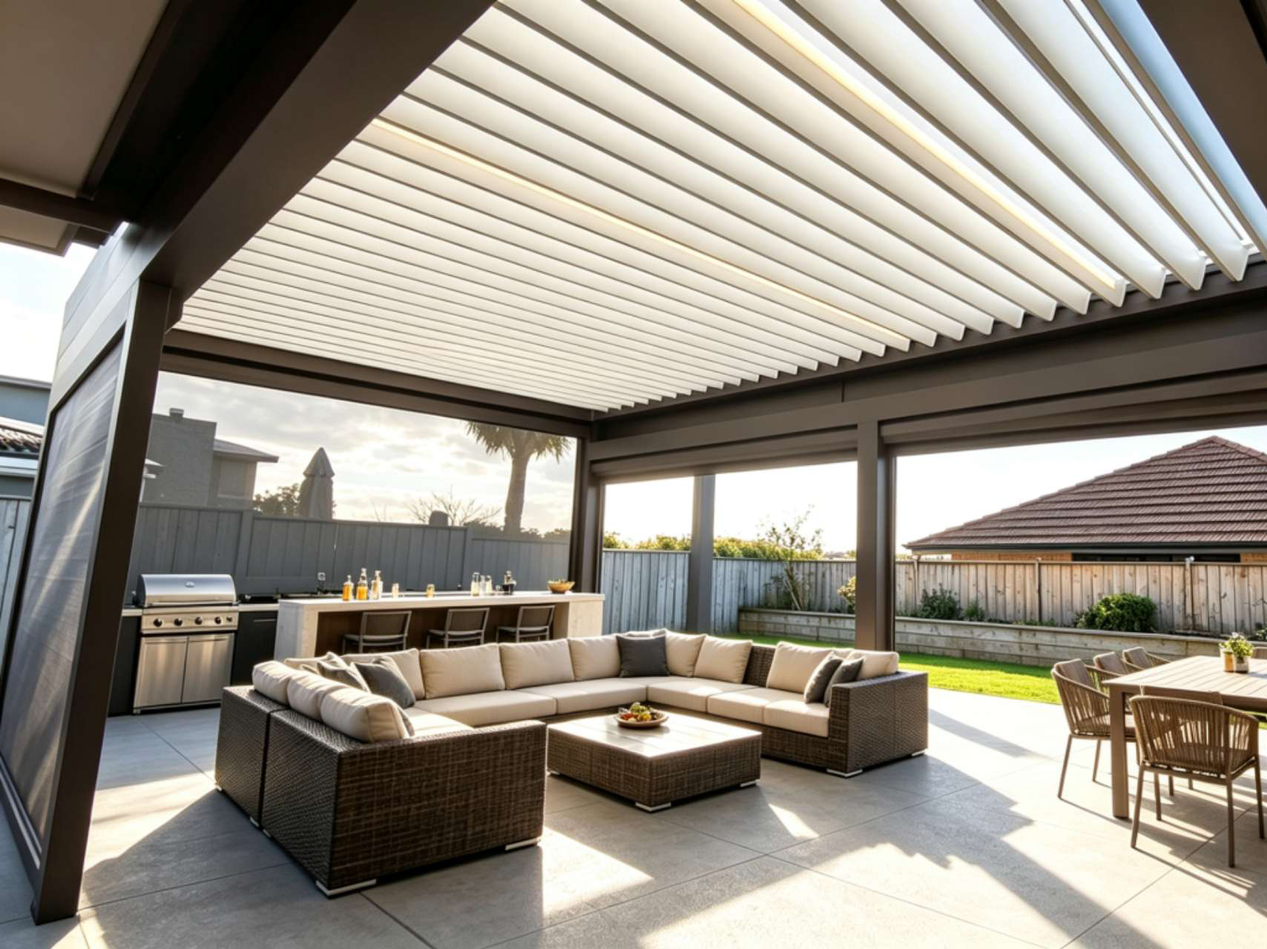
Pergola blinds are the layer most New Zealand homeowners add second, after the louvre roof. A new louvre roof solves the overhead question, and the first time it rains and the deck stays dry, every minute of the install is worth it. By the third windy Sunday in a row, most owners notice the next thing: the sides of the space are still open, and on most days that matters.
Pergola blinds are the answer. They are a sealed-edge, motorised side closure that runs in vertical tracks down each pergola post, dropping when you want shelter and rolling up when you want airflow. With the roof handling above and the blinds handling the sides, what was a covered patio becomes an outdoor room you actually use 12 months of the year.
This guide walks through what outdoor blinds do, what fabrics to choose from, how to pick the right combination for your project, and what to know about installation before you request a quote. For details on the louvre roof itself, see the 2026 Aluminium Pergola Buyer’s Guide.
The four jobs pergola blinds do
Pergola blinds add four distinct things to an outdoor space. Most projects need at least two of them done well, and the right setup follows from which jobs matter most.
Sun and glare control. The most obvious job. Mesh or solid fabric blocks the late-afternoon sun on west-facing sides, keeps furniture and timber decking from UV bleaching, and makes the space usable on hot days.
Weather and wind protection. The less obvious job, but the one that determines whether the space gets used in shoulder season. A side-rain shower drives in under a louvre roof at 45 degrees and ruins an evening, even with the roof fully closed. Wind does similar work on cooler days. Blinds on the wind-prone sides solve both.
Privacy and visual screening. In Ponsonby, Grey Lynn, or any suburb where neighbours sit close on one or two sides, a blind on those sides turns a watched patio into a private outdoor room. The same blind can be retracted when you want the open feeling back.
Insect and pest protection. The job most homeowners only think of after the first warm evening. A sealed-edge ZIP blind closes the gap between roof and floor cleanly enough to keep mosquitoes, flies, and other pests out of the space, which makes summer dining usable after sunset. This is one of the more common motivations for adding blinds to a louvre roof in Auckland summers.
Pergola blinds fabric options: mesh, PVC, clear PVC, or acrylic
All Louvresky pergola blinds are motorised ZIP roller blinds. The hardware is the same across every project: a tubular motor, a sealed track on each side of the opening, and a roller at the top that takes the fabric up and down. The fabric itself is available in a range of custom colours so the blinds match the pergola finish and the home behind it. What changes between projects is which fabric goes inside the track.
Each fabric handles the four jobs differently. Most projects use a mix, for example mesh on the sun-facing sides and clear PVC on the wind-prone sides, to get the right balance per direction.
| Fabric | Best for | Trade-off |
|---|---|---|
| Mesh (semi-visible) | Sun and UV control while keeping the view through, light wind, common on west-facing patios | Not rain-proof; the view goes both ways at night with lights on inside |
| Clear PVC | Full weather protection from rain and wind, keeps the view, retains warmth from an outdoor heater | Can fog when cold and warm air mix, not breathable |
| Solid PVC | Full weather protection plus privacy | Blocks the view when down, less daylight comes through |
| Acrylic | Privacy and block-out on exposed coastal sites | Blocks the view when down, heavier appearance |
The motor and control system runs on a tubular motor across all fabric choices, with single, 2-, 5-, or 9-channel control options so multiple blinds can be grouped onto one remote.
How to pick the right combination for your pergola
A useful rule of thumb: think one side at a time, not the whole pergola at once. Each side faces a different direction, gets a different amount of sun and wind, and may have different privacy demands. The right blind for each side often differs.
Here are the four most common patterns we install.
Shade and breeze on hot afternoons. Mesh on the sun-facing sides only, with other sides left open. The cheapest setup and ideal if you mostly want to extend summer use.
Year-round use through winter. Clear PVC on the wind-prone sides, mesh elsewhere, optional outdoor heater for shoulder season. This is the most common all-rounder configuration.
Neighbours close on one side. Solid PVC or acrylic on the privacy-needed side, mesh on the others. The privacy fabric retracts when you want openness back.
Exposed coastal site. Acrylic or solid PVC fabric for wind and salt-spray resistance, paired with a heavy-duty louvre roof system overhead.
The cost per side changes meaningfully depending on the fabric choice, so it is worth deciding which side does which job at the design stage rather than retrofitting later.
Installing pergola blinds: what shapes the quote
A few things shape the install and the eventual quote.
Designing in vs retrofitting. Installing blinds when the pergola is built is cleaner and usually less expensive than adding them afterwards. The blind tracks need a solid mounting surface, and the easiest mounting surface is a Louvresky aluminium pergola frame that was specced from the start to take them. You don't need a Louvresky pergola, though. We can fit ZIP blinds to an existing pergola built by another company, as long as the structure gives the tracks a solid mounting surface to attach to.
Motorised operation as standard. Louvresky ZIP blinds run on a tubular motor, controlled via remote with single-channel, 2-channel, 5-channel, or 9-channel options. The multi-channel options let you group blinds by direction so the sun-side blinds drop on one channel and the privacy-side blinds drop on another, which is more useful day to day than it sounds.
Wind tolerance. Louvresky’s ZIP blinds are rated to 120 km/h wind resistance. That covers most weather most Auckland homeowners will experience; on the rare occasion that gusts exceed the rating, follow the retract guidance.
Other rated specs. The fabrics are waterproof, fireproof, UV proof, and windproof rated, with a UV Protection Factor of 80+. The combination means the same blind handles rain showers, summer sun load, and gust events through the seasons without being swapped out.
Warranty. A 3-year warranty covers the blinds themselves, sitting within the broader Louvresky 2 to 10 year component-based warranty schedule that applies across the rest of the system depending on the component.
Cleaning and maintenance. A yearly rinse with fresh water and periodic track lubrication keeps the system performing. There is no annual professional service required.
Pairing pergola blinds with your Louvresky louvre roof
The sections above cover the blinds. This section covers the practical considerations when adding them to each Louvresky roof line. The product specs live on the individual product pages and are linked below.
Mana. The flagship louvre roof, built with stainless steel and brass fittings for coastal exposure, with an approved maximum wind rating of 220 km/h. The structural side handles the load, so on a Mana install the fabric choice is where most of the decision sits. Our portfolio project A Coastal Transformation is a real example: a custom louvre pergola for a seaside home paired with retractable side blinds for glare control and privacy.
Toa. The standard residential and light commercial louvre roof, with standard-thickness aluminium blades and high-quality composite fixings. The widest installation base for blinds: a typical Auckland setup is a Toa louvre roof with mesh or PVC blinds on one or two sides.
Te Pō. A fully retractable louvre roof, motorised with remote and smart-home integration. Te Pō and the ZIP blinds each run on their own motorised systems, so both can be operated independently. Owners with broader smart-home setups often bring them together at the platform level (rather than expecting one physical remote out of the box).
Rangi. A separate retractable patio roof system from the louvre roof lines above. Rangi has fully retractable louvres with motorised control, and the product page notes it integrates with pergolas, verandas, and other outdoor roof systems. Where Rangi is the main roof, side blinds are a natural complement on the open faces; where Rangi extends an existing pergola, side blinds typically attach to the pergola frame.
See the full lineup on the aluminium pergola range and the functional blinds range.
What to know before requesting a pergola blinds quote
Coming to the quote conversation with these decisions roughly worked out makes the rest much faster.
- How many sides you want enclosed with blinds. One, two, three, or all four. The sun-facing side is the most common starting point.
- The direction each side faces. Sun and wind exposure determines fabric choice.
- Which fabric transparency you want on each side. Transparent, semi-transparent, or opaque. You can use the same across every side or mix them by direction, which is the more common choice.
- How you want to control the blinds. Two ways: a handheld remote, or a control on the unit itself.
- Whether the pergola is existing or being designed at the same time. Retrofitting works fine, but designing in from the start is cleaner.
Plan your outdoor room with Louvresky
If you are turning a louvre roof into a full outdoor room, the next step is straightforward.- Showroom: 177 Morrin Road, Saint Johns, Auckland. Working systems and blinds on display, fabric samples to compare in hand. Open Monday to Friday 9:00am to 5:00pm and Saturday 10:00am to 4:00pm.
- Phone: 0800 006 888 for any quick questions.
- Quote: request a custom quote for the complete outdoor room (pergola + blinds), or for blinds only if your pergola is already installed.
- Browse: the functional blinds range to see fabrics, control options, and finishes before your visit.