Retractable Awning vs Retractable Louvre Roof: How Do Rangi and Te Pō Differ?
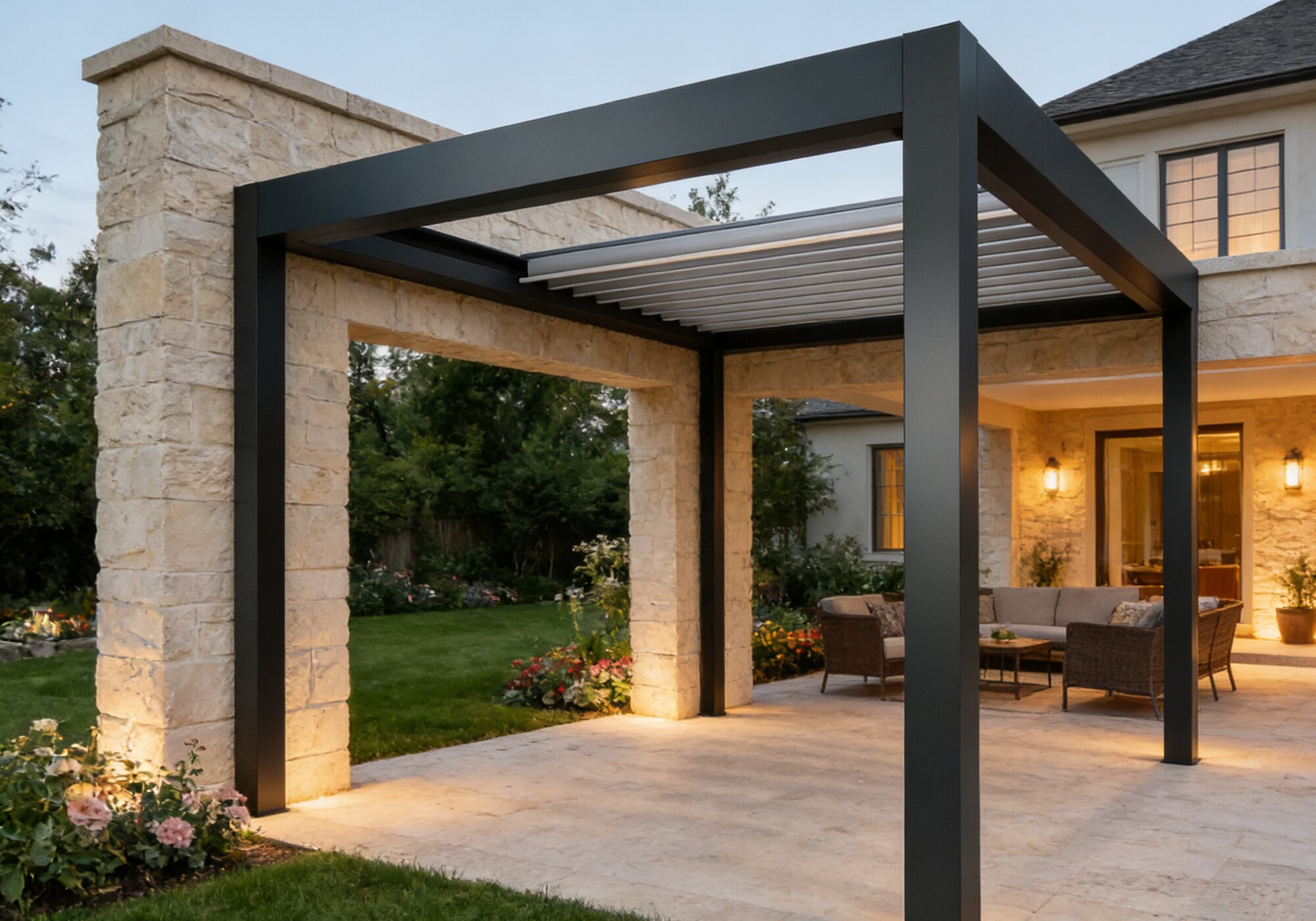
A retractable awning and a retractable louvre roof both give you back the sky, but they do it with different materials: Rangi retracts fabric, and Te Pō retracts aluminium blades.
To show how this choice usually plays out, here is a hypothetical example. Hana and Mark are not real clients; they are an invented couple in Mount Eden, used here to walk through the questions we hear most often. Say their deck faces west. It is the best spot at the house until late afternoon, when the sun comes straight across the table and the living room behind it starts to warm up. Then a shower rolls through and everybody carries the plates inside.
In this example, Hana wants shade but does not want to lose the sky. The garden is the reason they bought the place, and a permanent roof feels like giving up the thing they like most. She has spent an evening under a neighbour's retractable awning and is sure of the answer.
Mark has seen a friend's louvre roof and is just as sure of a different answer.
So the deck becomes an argument. Each of them has a favourite, and each treats the other's favourite as the lesser choice. Photos and product pages do not settle it. Retractable awning, retractable roof, retractable louvre. It all starts to sound like the same thing at different levels.
In a situation like this, the most useful question at a site measure is a simple one: when the cover is out, what do you want to be looking up at?
Asked that, Hana would talk about fabric, the soft light under it and the way it sits with the garden. Mark would talk about clean aluminium lines that match the window joinery. At that point it becomes clear they are not really arguing about which product is better. They are describing different roofs.
Rangi and Te Pō are not levels of the same product. They are different products that answer different questions.
If your household is having the same conversation, a short call can save a few weekends of reading. Ring 0800 006 888, tell us what the space faces and how you use it, and we can talk through which system fits.
What Hana and Mark Were Really Comparing
The confusion is understandable, because the word retractable is doing a lot of work in this category.
Rangi is our retractable awning. It uses an aluminium frame with a fabric cover that extends and retracts. When it is out, it gives you shade and shelter from rain.
Te Pō is our retractable louvre roof. It sits in the louvre roof family, and its aluminium blades slide back when you want the sky and run out when you want cover.
So the shared idea is simple: a roof that moves out of the way. Almost everything else follows from what is moving. Fabric and aluminium look different, sound different in the rain, filter light differently and suit different houses. That is why we treat them as separate products and never as a good and better pairing.
Both can be made in a standard size or fully custom to your space, so the comparison is about fit and character, not about who gets the bigger or smaller version.
The Case for Fabric
Hana's case for Rangi comes down to how the deck feels.
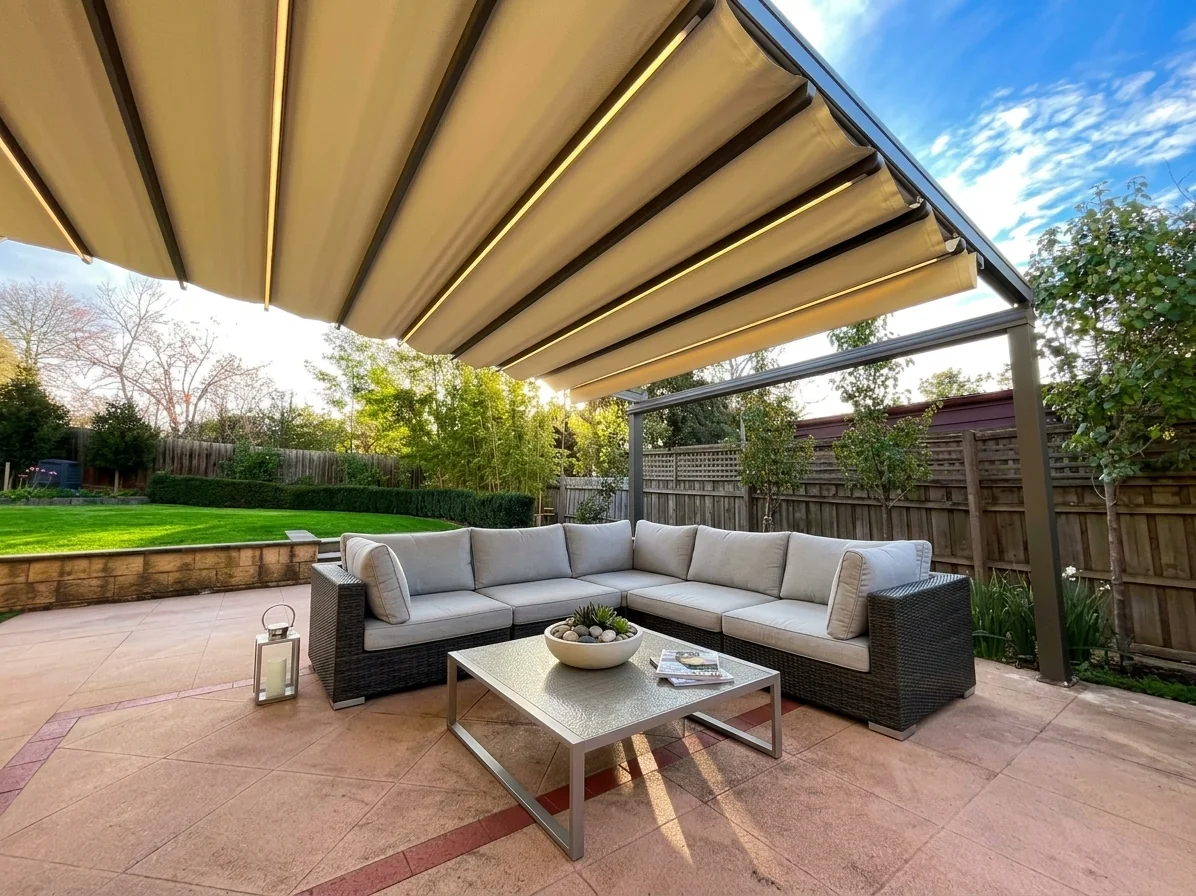
Fabric softens a space. The light under it is even and gentle, which is what Hana remembered from that evening at the neighbour's. Low western sun is a separate question, because it comes in at an angle beneath an overhead cover, so on a west-facing deck we assess it on site. What Hana liked was how a fabric cover sat quietly against a planted garden.
Fabric also suits people who think of the deck as an outdoor space first and a covered space second. Extend Rangi when the sun or a shower calls for it, retract it when you want the garden back. For a household like Hana and Mark's, that matches how they already use the deck.
Being fair to the material matters too. Fabric has a finite service life, and we talk that through at quote stage so nobody is surprised. It comes with the character of a fabric roof, in the same way that blades come with the character of aluminium.
The Case for Blades
Mark's case for Te Pō is about the house.
In our example, their home has dark window joinery and strong horizontal lines. An aluminium blade roof picks up that language. It reads as part of the architecture, and when the blades are out overhead you have the look of a louvre roof, with the option of sliding those blades away.
That combination is what sets Te Pō apart from the rest of our louvre roofs. Mana is our heavy duty louvre series, built for bigger spans and higher wind exposure, with blades that tilt. Te Pō is the series where the blades themselves retract.
What Happens When the Rain Comes Through
The next question is usually the practical one. If a shower arrives while friends are over, what happens?
With either system, you bring the cover out. Rangi gives you shade and rain shelter when extended. Te Pō gives you shade and rain shelter when the blades are out.
What we would tell Hana and Mark is that the bigger rain question sits at the edges of the deck. Where does the water go once it leaves the roof? Which way does the weather usually come from? What is underneath, and what sits beside it? We look at those details on site, for either product, because the answers belong to the house.
This is often the point where people stop asking which product handles rain better and start asking how each one would be fitted to their deck. That is a far more useful conversation.
The product decides how the roof looks and moves. The site decides how it needs to be installed.
How the House Got a Say
Up to this point the choice would be about taste. Then the house itself would have a say.
The fitting details depend on what the structure attaches to, how the deck is built and how the roofline sits. Decks are worth checking early, because post positions often need strengthening, and that is true at ground level as well as upstairs.
Colour might come up next. The colour and finish would be chosen to suit the house, for example to sit well with the window joinery. Both products can be made in a standard size or fully custom, so the proportions would be worked out for the space. For a couple like Hana and Mark, that might take some of the heat out of the debate. Whichever way they go, it would be measured to their deck and made to suit it.
Our process stays the same for both: a site measure, custom manufacture and installation. Every project is quoted individually, which is also why we do not rank these two on price in general terms. The number depends on your space, not on the name of the series.
What If a Cafe Owner Asked the Same Question?
The same choice turns up in commercial work. A cafe owner in Hamilton might start with the same search as Hana and Mark, then find that the question sounds a little different.
For a shopfront or courtyard, it is usually about how the outdoor seating should feel from the street. Some owners want the soft, relaxed look that fabric gives a terrace. Others want an architectural roof that lines up with the building. Both are sensible briefs, and both systems can suit commercial spaces.
The test is the same one Hana and Mark faced in our example. Stand in the space, look up, and decide what you want to see there on a normal working day.
How Hana and Mark Might Decide
In this example, the garden would probably tip the choice towards Rangi.
Mark's aluminium lines are a real argument, and on a different house Te Pō could easily come out ahead. Because Hana and Mark want the cover to feel like part of the garden, and are happy for fabric to set the mood on the deck, fabric fits. Mark's wish for a neat finish that matches the joinery is something we would work through in the design.
A family two streets away, with a modern home and a strong roofline, could look at the same two products and choose Te Pō for equally good reasons. Neither result would be a compromise.
If you are working through the same choice, these are the signs we look for. Rangi tends to suit you if:
- You like the soft light and relaxed look of a fabric roof
- Your deck leans towards the garden and you want the cover to sit quietly with it
- You think of the deck as an outdoor space first and a covered space second
Te Pō tends to suit you if:
- Your house has strong lines, such as dark joinery or a modern roofline, and you want the cover to pick them up
- You would rather look up at clean aluminium blades than at fabric
- You see the cover as part of the building more than part of the garden
What to Bring to Your Own Measure
You do not need to have picked a side before we meet. A few simple things make the first conversation much more useful:
Take photos of the space from the house and from the far end of the deck. Note where the sun sits when it bothers you, and which direction your weather tends to come from. Then have the same talk as Hana and Mark in our example: when the cover is out, what do you want to be looking up at?
Send those details through our quote request form and we will come back with a recommendation for your site, a measure and a quote made for your space, whether that turns out to be Rangi or Te Pō.
Rangi and Te Pō FAQs
What is the difference between a retractable awning and a retractable louvre roof?
A retractable awning such as Rangi uses an aluminium frame with a fabric cover that extends and retracts. A retractable louvre roof such as Te Pō uses aluminium blades that slide back and run out. They are different products, so the choice comes down to the look and feel you want and how each one fits your home.
Can a retractable awning handle rain?
Rangi provides shade and shelter from rain while it is extended. We look at how water will run off the cover and where it will go as part of the site measure.
Which costs more, Rangi or Te Pō?
There is no general answer, because both are made to measure and every project is quoted individually. The size of the space, the site and the options you choose all shape the quote.
Do these systems need building consent?
Consent requirements depend on the scale of the project and the site, and not every project needs it. Where consent is required, there are additional costs covering items such as the engineer, designer and council, and these are assessed and quoted separately. Your local council can confirm the position for your property, and the government building guidance on consent exemptions is a useful starting point.
Can Rangi or Te Pō be used for a cafe or commercial space?
Yes, both can suit commercial outdoor areas as well as homes. We measure the space and design the system around how the area is used.